
Indian benchmark indices Sensex and Nifty experienced a significant tumble in early trade, driven by surging global oil prices, continuous outflows by Foreign Institutional Investors (FIIs), and persistent geopolitical uncertainties, particularly in West Asia.

Indian benchmark equity indices, Sensex and Nifty, saw a rebound in early trade, driven by a rally in global markets and easing Brent crude oil prices, with hopes of US-Iran peace negotiations also contributing to investor optimism. Track Sensex, Nifty on May 22

Domestic Institutional Investors (DIIs) have significantly increased their holdings in Nifty 500 companies, reaching a record 20.9 per cent by the end of March, while Foreign Portfolio Investors (FPIs) reduced their ownership to an all-time low of 17.1 per cent, according to Motilal Oswal Financial Services.

Indian equity benchmark indices experienced a significant drop in early trade, with the BSE Sensex falling over 525 points and the NSE Nifty down more than 164 points, primarily due to rising crude oil prices and ongoing uncertainty surrounding the US-Iran conflict.

Indian benchmark equity indices, Sensex and Nifty, saw gains in early trade, driven by strong performance in banking shares and positive sentiment from Asian markets, alongside optimism surrounding the ongoing US-China Summit.

Sensex gains over 400 points while Nifty trades above 23,800 amid strong IT sector buying.

Indian benchmark equity indices, the BSE Sensex and NSE Nifty, experienced a significant drop in early trade due to elevated oil prices, weak global market trends, and renewed fears of military operations in the Middle East following US President Donald Trump's statements regarding Iran. Track Sensex, Nifty on May 20.

Indian stock markets experienced a significant sell-off, with the Sensex tumbling over 1,300 points, driven by escalating crude oil prices due to US-Iran tensions and Prime Minister Narendra Modi's call for austerity measures, which amplified investor concerns about India's economic outlook.
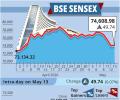
Indian benchmark equity indices, Sensex and Nifty, closed marginally higher, breaking a four-day losing streak, despite elevated crude oil prices and ongoing geopolitical uncertainties. The market saw a temporary pause in panic selling, though cautious sentiment persists.

Indian benchmark indices, Sensex and Nifty, closed marginally higher after a volatile trading session, driven by value buying in IT and select blue-chip counters, despite global crude price hikes and a weak rupee.
Indian benchmark indices, Sensex and Nifty, ended lower in choppy trade, with the Sensex declining 114 points, as investors reacted to unabated foreign fund outflows and rising geopolitical uncertainties.

Indian stock markets rallied in early trade after US President Donald Trump announced a halt to planned military strikes on Iran, citing requests from Gulf leaders and ongoing "very big discussions" that could lead to a deal. This de-escalation, coupled with foreign fund inflows and gains in IT and Adani group stocks, contributed to the positive market sentiment. Track Sensex and Nifty on May 19, 2026.

Indian benchmark indices Sensex and Nifty experienced a significant slump in early trade, mirroring weak global trends, as escalating tensions in West Asia, particularly a drone attack on the UAE's Barakah nuclear facility, pushed crude oil prices higher. Track Sensex, Nifty50 movement and key market drivers for May 18, 2026.

'Once the currency goes out of the hand, then possibly your major challenge is that it will not come back.'
Indian equity benchmark indices, Sensex and Nifty, tumbled nearly 2 per cent for the fourth consecutive session, driven by elevated crude oil prices, escalating US-Iran tensions, unabated foreign fund outflows, and a depreciating rupee.
Indian equity benchmark indices, Sensex and Nifty, tumbled nearly 2 per cent for the fourth consecutive session, driven by elevated crude oil prices, escalating US-Iran tensions, unabated foreign fund outflows, and a depreciating rupee.
Indian stock markets saw a significant rebound, with the Sensex jumping nearly 790 points, primarily fuelled by strong buying interest in telecom, pharma, and private banking shares, despite a volatile trading session and a weakening rupee.
Indian benchmark indices Sensex and Nifty experienced volatile trade, declining in early deals before fluctuating, as investors reacted to unabated foreign fund outflows and rising geopolitical uncertainties, particularly in West Asia.
Indian stock markets concluded Tuesday's trading session lower, reversing intraday gains due to late-session selling in blue-chip stocks like HDFC Bank and Reliance Industries. The decline was primarily driven by the Indian rupee hitting a new record low against the US dollar and elevated global crude oil prices, compounded by geopolitical uncertainties.
Indian benchmark indices Sensex and Nifty closed higher, with the Sensex climbing 355.90 points, driven by positive state election results and better-than-expected Q4 earnings, despite ongoing geopolitical concerns.

Indian stock markets are expected to remain highly sensitive to geopolitical developments, particularly the US-Iran situation, and crude oil prices this week, with analysts also highlighting the influence of the rupee-dollar trend, foreign investor activity, and upcoming inflation data.

Indian investors have seen their wealth erode by a staggering Rs 16.77 lakh crore over four trading sessions, as the markets faced deep losses driven by elevated crude oil prices, geopolitical tensions, persistent foreign fund outflows, and a record-low rupee.

Foreign investors have withdrawn over Rs 88,000 crore from Indian equities this month, driven by geopolitical tensions, a weak rupee, and concerns about rising crude oil prices.

Leading Indian jewellery bodies, including the All India Gem & Jewellery Domestic Council (GJC) and Malabar Gold & Diamonds, have expressed support for Prime Minister Narendra Modi's appeal to reduce gold imports and are advocating for enhancements to the Gold Monetisation Scheme (GMS) to unlock India's vast idle gold reserves.

Indian benchmark equity indices, Sensex and Nifty, experienced a decline in early trade, ending a three-day rally, primarily due to heavy selling in IT stocks and concerns over prolonged instability in West Asia.

Indian stock markets are poised for volatility this week, driven primarily by the outcomes of five state assembly elections, ongoing high crude oil prices amid West Asia tensions, and the release of Q4 corporate earnings, according to market analysts.
Indian benchmark indices Sensex and Nifty experienced declines due to a sharp rally in crude oil prices, continuous foreign fund outflows, and geopolitical uncertainties. Regulatory developments in the banking sector, particularly the implementation of the Expected Credit Loss (ECL) framework, also contributed to the selling pressure.
Indian markets on Dalal Street rallied sharply as easing tensions in the US-Iran conflict and stable oil prices boosted sentiment. Track Nifty 50 and BSE Sensex performance and key global triggers.
Indian equity benchmark indices Sensex and Nifty tumbled over 1 per cent for the third consecutive day, driven by a sharp rally in crude oil prices, massive selling in IT stocks, and unabated foreign fund outflows amid ongoing geopolitical tensions in the Middle East.

Indian markets on Dalal Street rallied sharply as easing tensions in the US-Iran conflict and stable oil prices boosted sentiment. Track Nifty 50 and BSE Sensex performance and key global triggers.
Indian benchmark equity indices, Sensex and Nifty, snapped a three-day rally, tumbling nearly 1 per cent due to heavy selling in IT stocks, a jump in crude oil prices, foreign fund outflows, and fears of prolonged instability in West Asia.

Chinese leaders, including its generals, will have to weigh whether they can win a war if they ever attack Taiwan and if at all, can they sustain the subsequent devastation, notes Rup Narayan Das.

Indian stock market indices Sensex and Nifty experienced a decline in early trade due to surging crude oil prices and ongoing geopolitical uncertainty in West Asia. Foreign fund outflows further contributed to the negative sentiment.

Onestruction Inc and DataKaveri Systems have signed an MoU to establish a framework for strategic and technical collaboration in urban and built environment data exchange.

Indian stock market benchmarks Sensex and Nifty closed higher on Tuesday, buoyed by a drop in crude oil prices, a rally in global markets, and strong buying in IT stocks.
Indian benchmark stock indices, Sensex and Nifty, closed nearly 1 per cent lower following the collapse of US-Iran negotiations, which heightened concerns of a prolonged conflict in West Asia and drove crude oil prices sharply higher.
Indian benchmark indices Sensex and Nifty surged over 1 per cent, with the Sensex jumping 918.60 points, driven by strong buying in banking and financial counters and a positive trend in global equities, fuelled by hopes of easing West Asia tensions.

The Congress party has directed its MPs to attend Parliament and protest against the FCRA Amendment Bill, describing it as unconstitutional and a threat to minority organisations. The government asserts the bill aims to enhance transparency and prevent misuse of foreign funds.
From the 30-Sensex firms, Tata Consultancy Services, Asian Paints, Maruti, Sun Pharma, Hindustan Unilever, ICICI Bank, Kotak Mahindra Bank, Tech Mahindra, HDFC Bank and Larsen & Toubro were among the biggest laggards. On the other hand, Tata Steel, NTPC, Axis Bank and UltraTech Cement were among the gainers.

Mcap of top 6 most valued firms drops nearly Rs 65k cr; Airtel biggest laggard
 © 2026 Rediff.com - Advertise with us - Disclaimer - Privacy Policy - Sitemap - Feedback - About us - Terms of use - Grievances